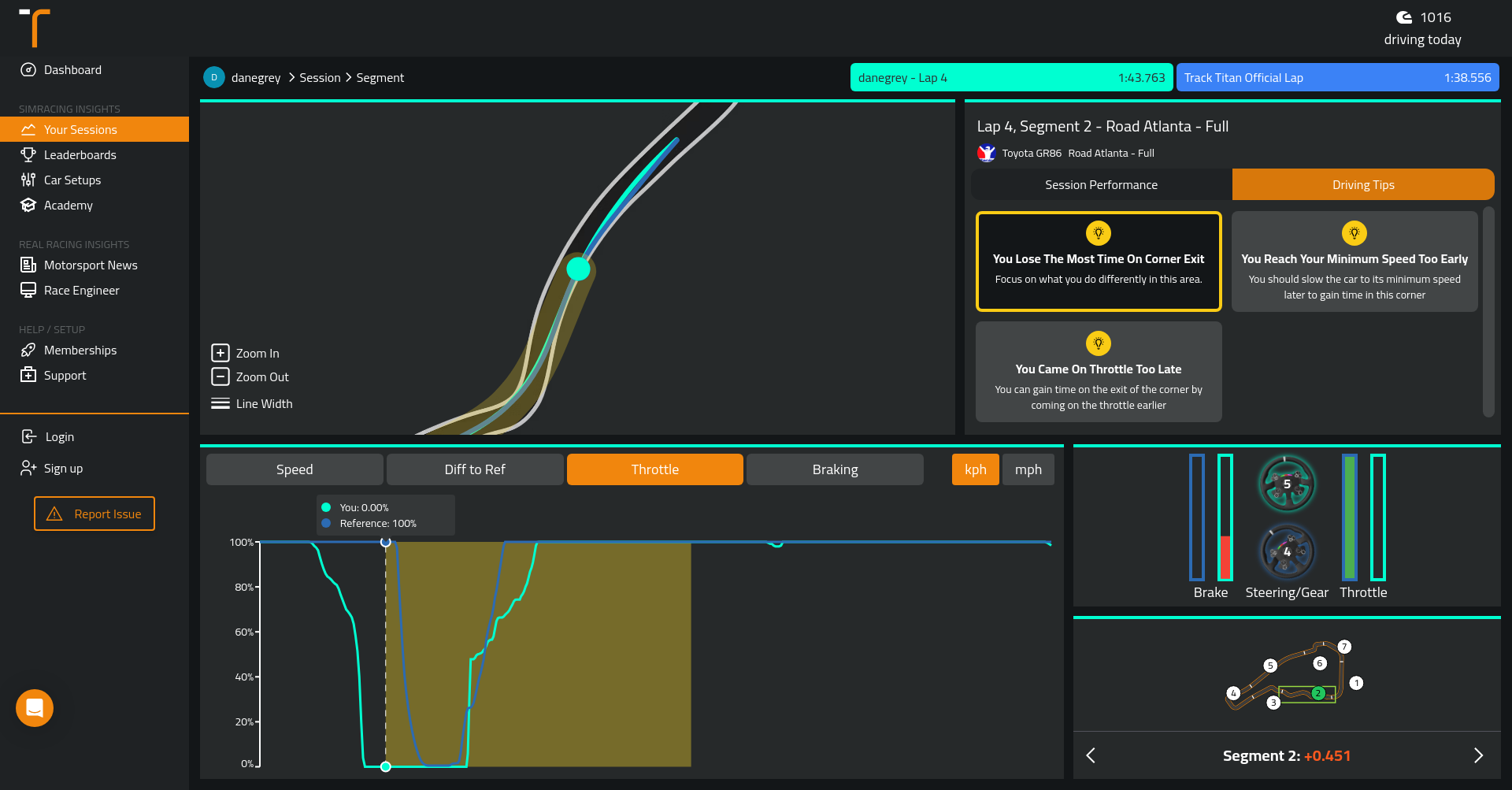
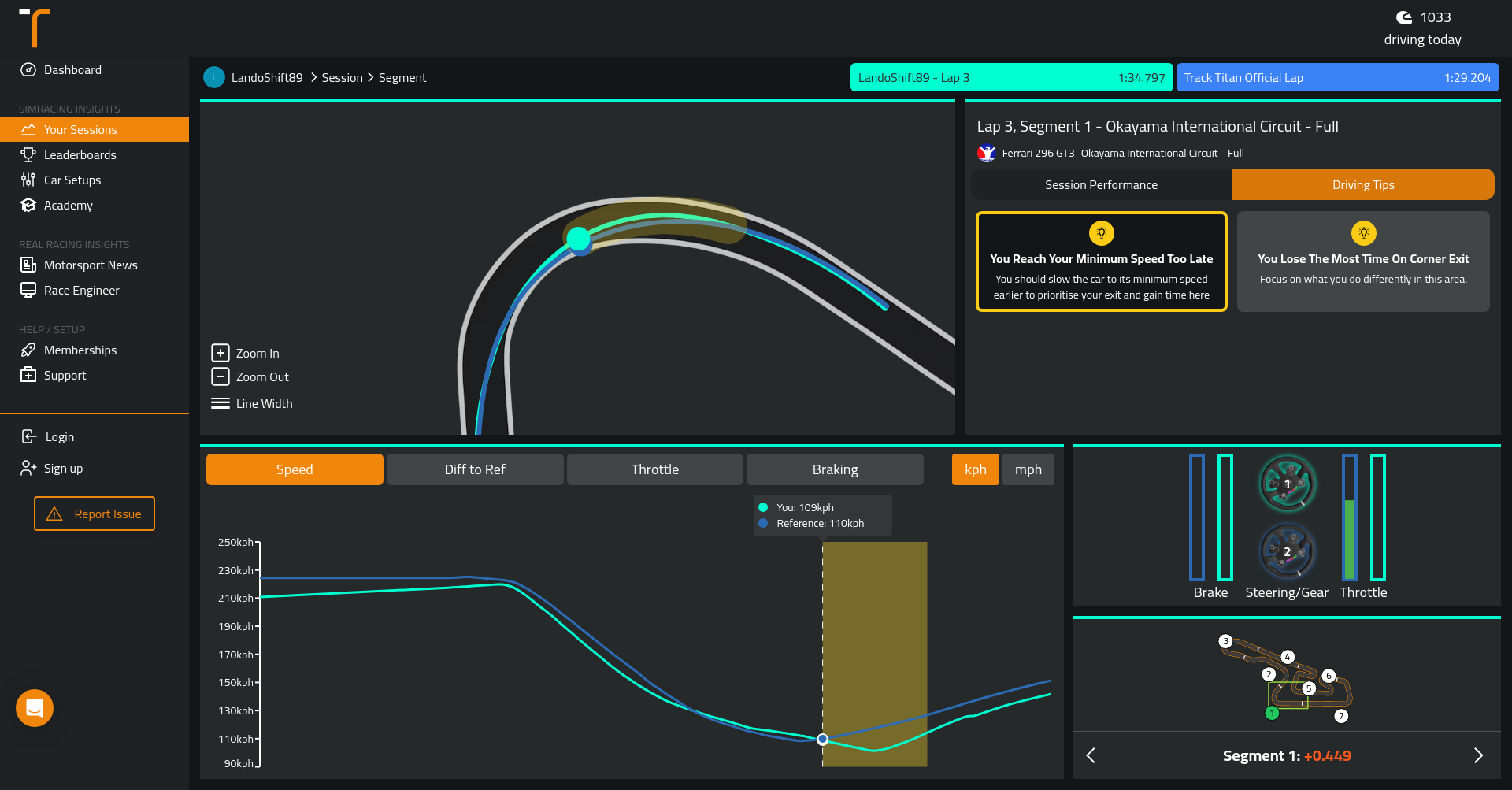
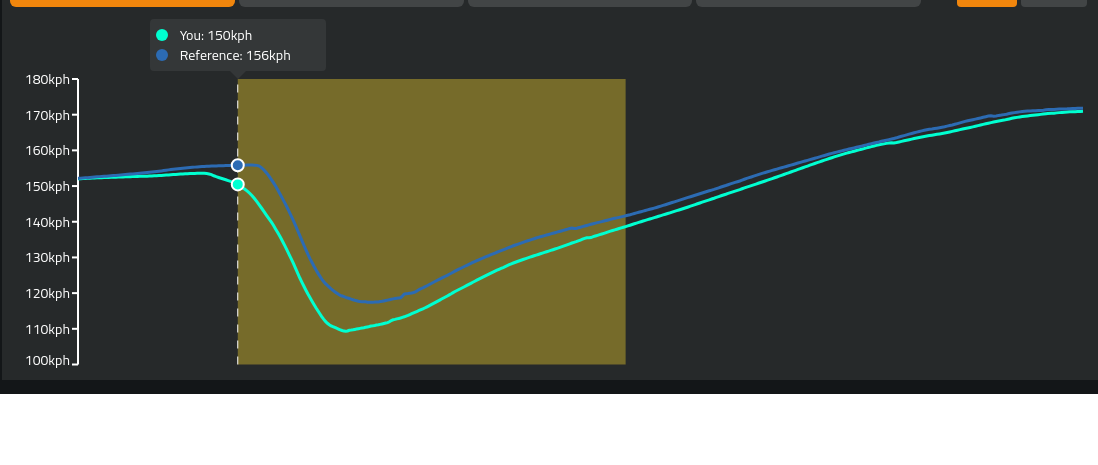
The speed chart analysis reveals that driverB is consistently slower than driverA, particularly at corner exits. DriverB's initial speed is lower, indicating a poor exit from the previous corner, and they decelerate too early before the next corner, losing momentum. Their acceleration out of the corner is also delayed and less aggressive than driverA's, leading to a slower exit speed. To improve, driverB should carry more speed from the preceding corner, delay their deceleration to align with driverA's timing, and get on the throttle earlier to maximize acceleration.
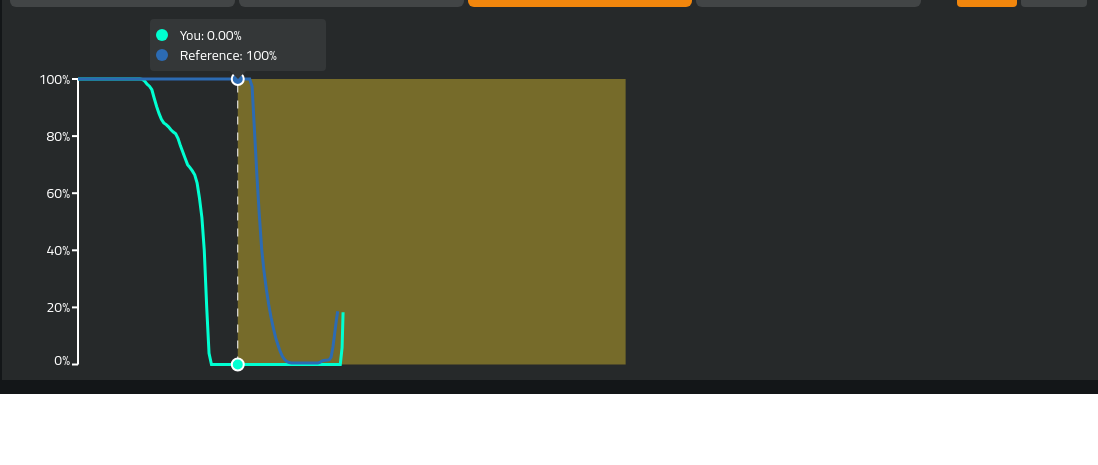
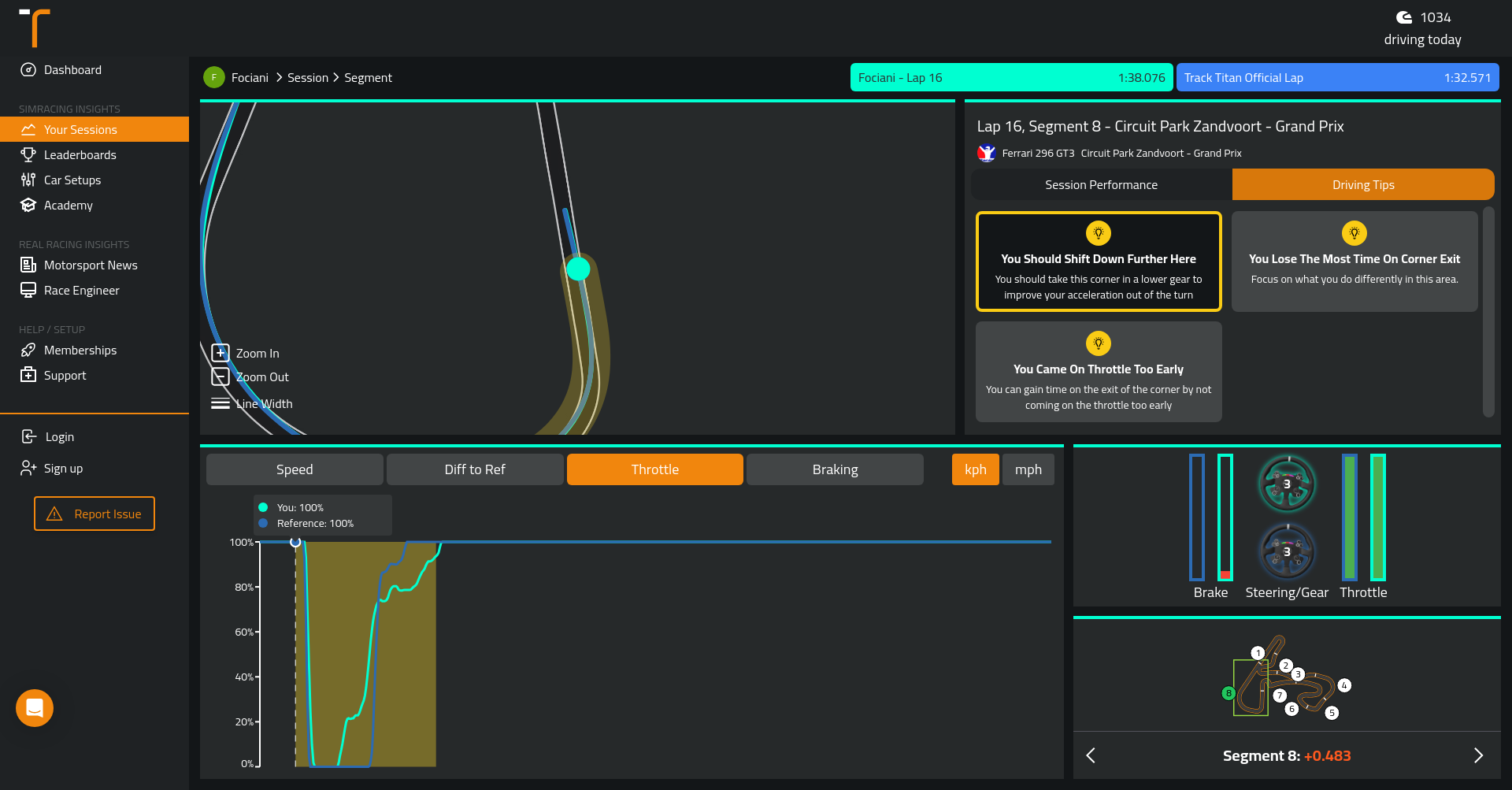
In terms of throttle control, driverB applies full throttle almost immediately after braking, showing an aggressive exit strategy. In contrast, driverA is hesitant and gradual in applying full throttle, resulting in a loss of time on corner exit. DriverB's confident commitment to full throttle contributes to their faster times. DriverA could improve by adopting a more assertive approach to throttle application post-braking phase.
Overall, for better performance on track sections involving corners, it is crucial for drivers to focus on maintaining higher speeds through efficient corner exits and assertive throttle control after braking. This can be achieved by carrying momentum from previous corners into the next ones, optimizing deceleration points and brake release timing, and committing confidently to acceleration once braking is complete.
Analyzing the speed chart, it's evident that driverB is losing significant time on corner exit compared to driverA. At the very start of the chart, driverB's speed is already lower than that of driverA, indicating a slower exit from the previous corner. This initial speed deficit carries through to the rest of the section. As they approach and enter the corner, driverB reaches their minimum speed earlier than driverA. This premature deceleration suggests a potential over-slowing for the corner, which contributes to a loss of momentum and time.
Furthermore, after hitting their minimum speed, driverB's acceleration phase is delayed and less steep compared to driverA's. This indicates that driverB is coming on throttle too late, which aligns with their slower corner exit speed. To improve performance in this section, driverB should focus on carrying more speed out of the preceding corner and work on delaying their deceleration point to match closer with that of driverA. Additionally, they should aim to get back on throttle earlier to maximize acceleration out of the corner and reduce time lost in this critical phase of the track section.
Analyzing the throttle control chart, it's evident that driverA is significantly delayed in applying full throttle compared to driverB. DriverB applies full throttle almost immediately after reducing brake pressure, indicating a more aggressive and confident corner exit strategy. This is highlighted by the sharp increase in throttle application for driverB, while driverA shows a more gradual and hesitant application.
Furthermore, driverA reaches full throttle at a much later point, suggesting a loss of time on corner exit due to this delayed response. The intensity of driverB's action is also noteworthy; they commit to full throttle with conviction, which likely contributes to their time gain in this section of the track. DriverA's tentative approach suggests room for improvement by adopting a more assertive throttle application once the braking phase is completed.