114,876
114K
Laps driven today

iRacing

Le Mans Ultimate

Assetto Corsa Competizione

Assetto Corsa

F1 25

Assetto Corsa EVO

Automobilista 2

Forza Motorsport

F1 24

F1 2021

F1 23

F1 2020


Lap 2
Segment 3
1:30.935
6th Feb 2024
Assetto Corsa Competizione
Donington Park - Ferrari 296 GT3

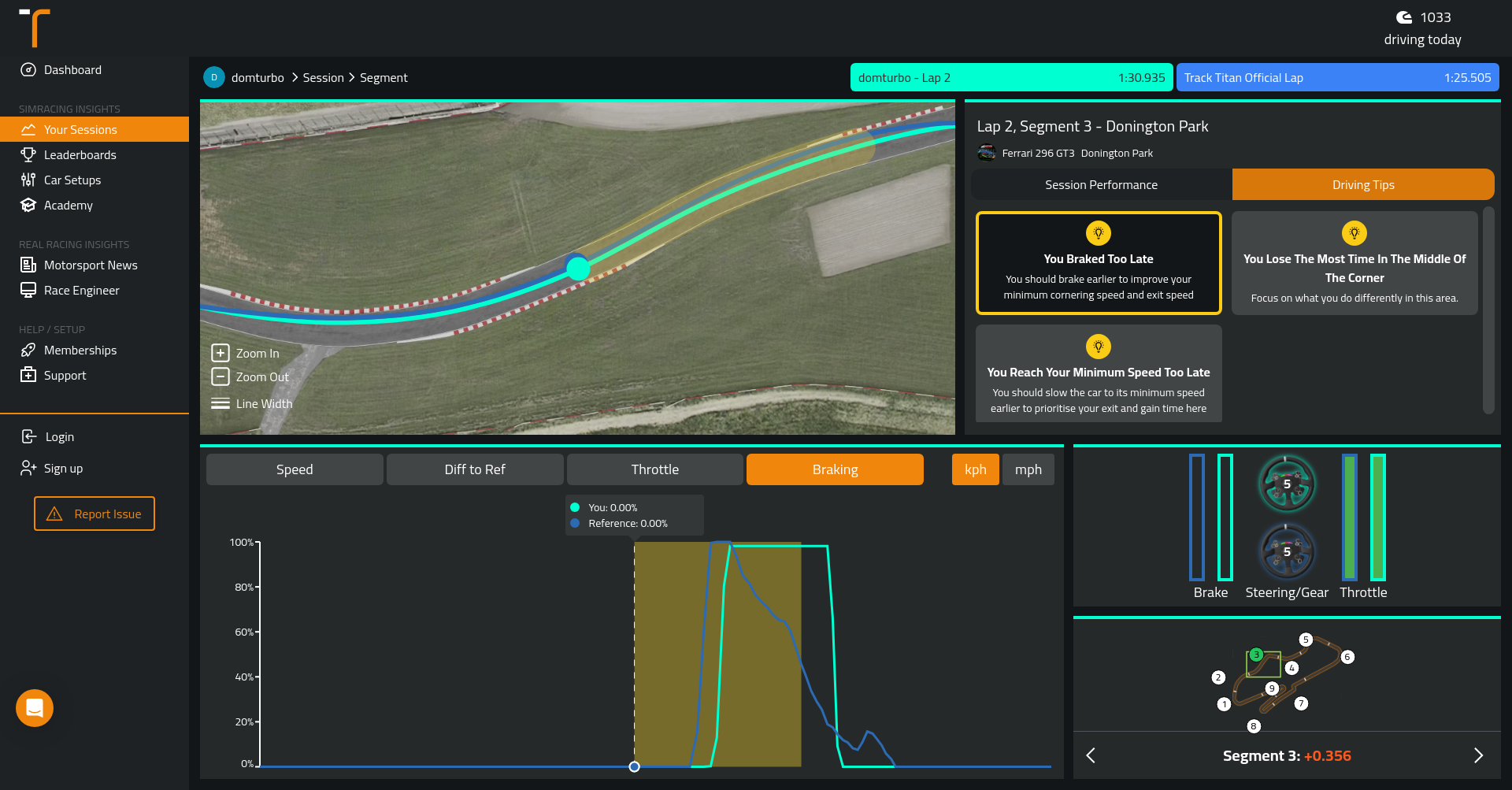
The speed chart analysis reveals that driverB enters the corner at a lower speed than driverA, indicating a loss of momentum from the previous corner and highlighting an area for improvement. DriverB's delayed deceleration leads to a lower minimum speed and later throttle application, resulting in time lost both in the middle of the corner and on exit. To enhance lap times, driverB should aim to brake earlier to achieve an earlier and higher minimum cornering speed, which will enable more effective acceleration on exit. In contrast, driverA's braking analysis shows a later but sharper initial brake application, carrying a higher minimum speed further into the corner. This aggressive braking is not ideal for optimal corner exit strategy. DriverA should instead focus on earlier and more progressive braking to maintain better mid-corner speed and facilitate a stronger exit. By adjusting their braking approach, driverA can potentially improve overall performance through corners.
Analyzing the speed chart, it's evident that driverB is entering the corner with a lower speed compared to driverA. This suggests that driverB did not carry as much momentum out of the previous corner, which is a critical area for improvement. Specifically, at the very start of the chart on the left, driverB's speed is already noticeably lower than that of driverA, indicating a loss of time even before reaching the current corner. As we progress through the corner, it becomes clear that driverB reaches their minimum speed significantly later than driverA. This delayed deceleration results in a lower minimum speed and consequently a later application of throttle. The impact here is twofold: not only does driverB lose time in the middle section of the corner where their speed should be optimized, but they also compromise their exit speed. The gradient of driverB's speed increase on exit is less steep compared to driverA's, highlighting a less effective acceleration phase and further time lost on corner exit. To improve lap times, focusing on braking earlier to achieve an earlier and higher minimum cornering speed will be crucial for driverB.

In the provided braking analysis chart, driverA exhibits a significantly later and sharper initial brake application compared to driverB. This is evident from the steep incline in driverA's brake application curve, indicating a more aggressive approach to slowing down. However, this late braking results in a higher minimum speed being carried further into the corner, which is not optimal for corner exit strategy as per the head coach's notes. DriverB, on the other hand, initiates braking earlier and with less intensity, as shown by the more gradual increase in their brake application. This allows driverB to reach their minimum speed sooner and potentially carry more speed through the middle of the corner, setting up for a better exit. DriverA needs to focus on applying brakes earlier and more progressively to improve their mid-corner performance and subsequent exit speed.